What's inside: the five actives
Ingredients
Five actives, and what is really known about each
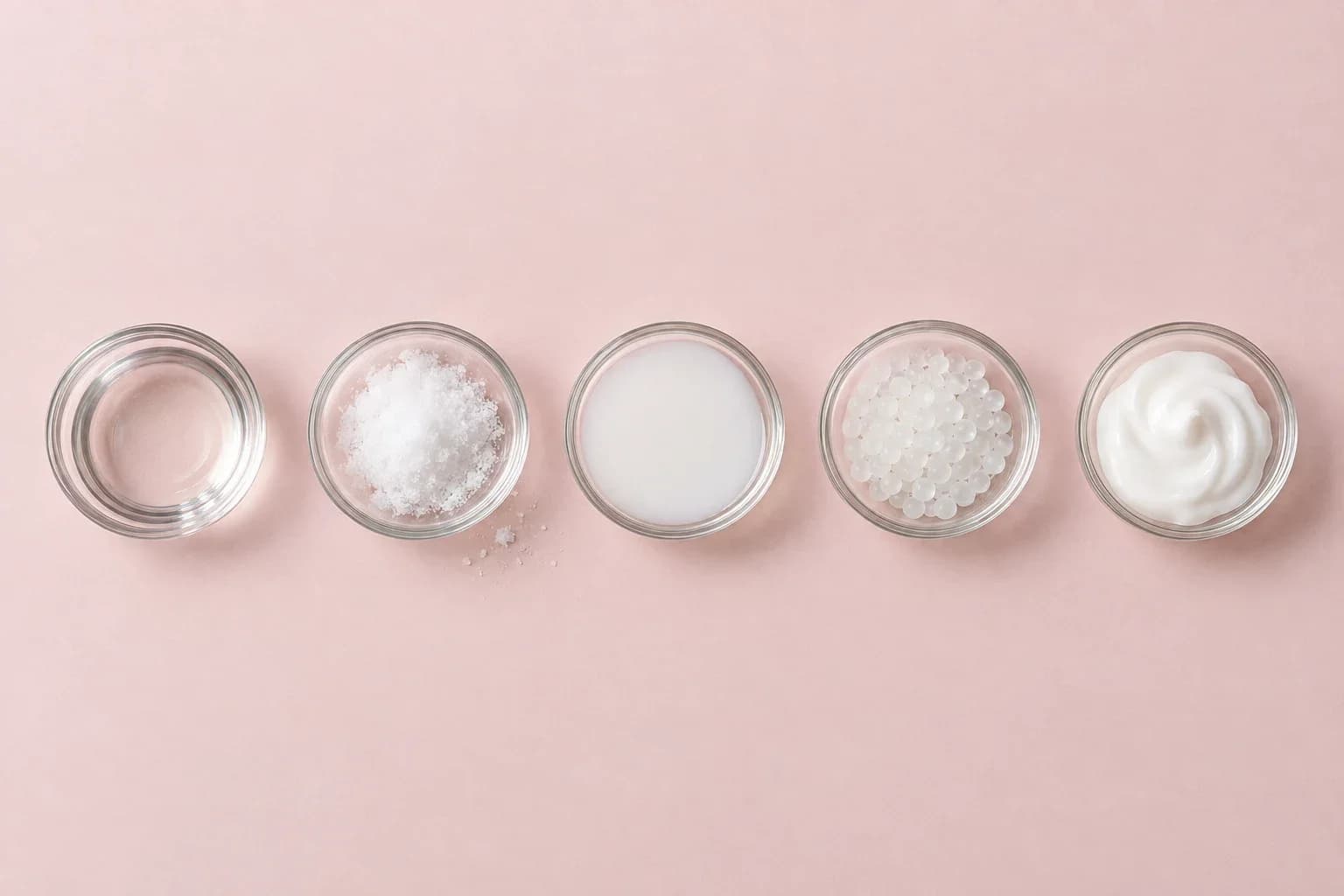
The cream has five actives: 7% glycolic acid, 2% salicylic acid, 1% lactic acid, 2% urea and 2% niacinamide. A percentage on a label tells you what is in the bottle, not what it will do for your skin. Most of the research was done at other strengths, on other parts of the body, or both. Where that is the case, we say so.
The five actives at a glance
| Ingredient | In the cream | What it is | Where the evidence stops |
|---|---|---|---|
| Glycolic acid | 7% | AHA | No study at 7% on body |
| Salicylic acid | 2% | BHA | Not measured on arms or legs |
| Lactic acid | 1% | AHA, found in skin | No exfoliation shown at 1% |
| Urea | 2% | Moisturizer, found in skin | Too low to loosen thick skin |
| Niacinamide | 2% | A form of vitamin B3 | Tone studied on faces only |
Glycolic acid, 7%
Glycolic acid is an acid found in sugarcane. With lactic acid, it is one of the two alpha hydroxy acids most used in cosmetics. An AHA makes the surface of the skin shed.
Picture the dead cells on top of your skin as tiles held by grout. AHAs loosen the glue-like substances that hold those surface cells to each other, so the cells come off. Glycolic acid has the smallest molecule of all the AHAs, which is why it is described as getting into skin easily. That description comes from a review of professional peels at 20 to 70%, not a 7% cream.
We found no study of a 7% leave-on glycolic cream on arms or legs. One hospital guide to face products also says glycolic acid can be very strong and irritating, and that you'll want to start slowly. That is why our directions say every other day for the first week if you are new to acids.
Salicylic acid, 2%
Salicylic acid is the beta hydroxy acid most commonly used in cosmetics, and like the AHAs it is an exfoliant. The difference is where it can go. AHAs are water-soluble acids. Salicylic acid dissolves in oil, so it mixes with the oily material inside the hair follicle, the pore.
Nothing we could find measured what 2% does on arms or legs: the research on salicylic acid and pores is about medicines, peels and face products. We can tell you it is oil-soluble and can work at the opening of the pore. We cannot tell you what it will do to yours.
Lactic acid, 1%
Lactic acid is the AHA found in sour milk. It is naturally present in skin: it is one of the outer layer's three natural moisturizing factors, along with urea and amino acids.
No source we read shows exfoliation from 1% lactic acid, and none gives a strength at which it adds moisture. The one trial on body skin we know of used 10% lactic acid, twice a day for 12 weeks, on the upper arms, ten times our amount. It says nothing about our cream.
What can be said: it is a second AHA next to the glycolic acid, which brings the cream's total to 8%, and something skin already contains.
Urea, 2%
Urea is naturally present in healthy skin, and dry skin conditions hold much less of it.
A review of its uses in dermatology places 2% to 10% in the range that moisturizes and supports the skin's barrier. Loosening rough, thick skin starts at 10% and above.
Our 2% sits at the very bottom of the moisturizing range and far below the loosening one. In this cream, urea is a moisturizer.
Niacinamide, 2%
Niacinamide, also called nicotinamide, is the water-soluble, active form of vitamin B3.
Its best-supported role is the skin barrier. In one study, nicotinamide applied to dry skin raised ceramide levels in the outer layer and lowered water loss. That study and the tone studies below were run by people working for cosmetics companies, and its published summary gives neither the strength used nor the body site.
On tone, niacinamide was tested on the face, at 5% in 18 people and at 2% combined with sunscreen in 120 people, for four weeks. Nothing we read tested it on arms or legs. We keep "supports the skin barrier" and make no promise about tone.
Why these five together
unberry started with one person's skin and a frustration, a story our About page tells. Our guide to strawberry skin explains the plug of keratin and dead cells at the mouth of the follicle, and our article on strawberry legs and keratosis pilaris tells the two apart.
The formula goes after the problem from three sides. Two AHAs work on the cells at the surface. An oil-soluble BHA can reach the oily opening of the pore. Urea and niacinamide are there for water and the barrier, because dermatologists warn that too much exfoliation can leave skin red and irritated.
That is our reasoning, not a tested result: nobody has tested these five together, in our smoothing body cream or in any study we could find. The cream is a cosmetic, not a medical treatment: if your skin is painful, very red or itchy, see a dermatologist.
What to know before you use acids on your body
- Sun. Sunscreen on exposed areas while you use the cream and for a week after. Arms and legs count. In studies the FDA reports, four weeks of AHA use raised the skin's sensitivity to UV reddening by 18%, and the effect was gone a week after stopping. The FDA does not give the strength used, so that number is not ours.
- Patch test. Try the cream on a small area first. The FDA advises you to test any product that contains a BHA on a small area before applying it to a large one.
- Skin that is not intact. Keep the cream off skin that is cut, sunburned, broken, irritated or freshly shaved, and stop if irritation occurs. Dermatologists say never to exfoliate open cuts, wounds or sunburned skin. Broken, irritated and freshly shaved skin are our own directions.
- Children. Keep the cream out of reach of children. The FDA advises avoiding BHA products on infants and children.
- Large areas. Ask a doctor or pharmacist first if you are allergic to aspirin or other salicylates, or in any doubt. The U.S. National Library of Medicine's sheet on salicylic acid as a medicine says not to apply it to large areas of your body unless your doctor tells you to. That sheet covers medicines at every strength, not a 2% cosmetic, but arms, thighs and legs are a large area.
- Pregnancy. If you are pregnant or breast-feeding, ask your doctor before using it.
Sources15 references
- U.S. Food and Drug Administration, Alpha Hydroxy Acids
- U.S. Food and Drug Administration, Beta Hydroxy Acids
- MedlinePlus, Salicylic Acid Topical
Show all 15 sourcesShow fewer
- American Academy of Dermatology, How to safely exfoliate at home
- DermNet, Alpha hydroxy acid facial treatments
- DermNet, Urea
- DermNet, Nicotinamide
- Cleveland Clinic, Facial Acids: Know What You Need in Your Skin Care Routine
- Tang and Yang, Dual Effects of Alpha-Hydroxy Acids on the Skin, Molecules, 2018
- Sharad, Glycolic acid peel therapy: a current review, 2013
- Arif, Salicylic acid as a peeling agent: a comprehensive review, 2015
- Kootiratrakarn et al., 10% lactic acid and 5% salicylic acid creams compared, 2015
- Piquero-Casals et al., Urea in Dermatology, Dermatology and Therapy, 2021
- Tanno et al., Nicotinamide and stratum corneum lipids, British Journal of Dermatology, 2000
- Hakozaki et al., Niacinamide and cutaneous pigmentation, British Journal of Dermatology, 2002
One cream, five actives
Glycolic Acid Smoothing Body Cream, for rough, bumpy-looking skin on arms and legs.
See the cream