Strawberry legs vs keratosis pilaris: three signs to check
Strawberry legs is the name of a look; keratosis pilaris is one of its causes. Three signs (touch, place, season) show if keratin is likely behind yours.
By The unberry team · October 6, 2026 · 6 min read
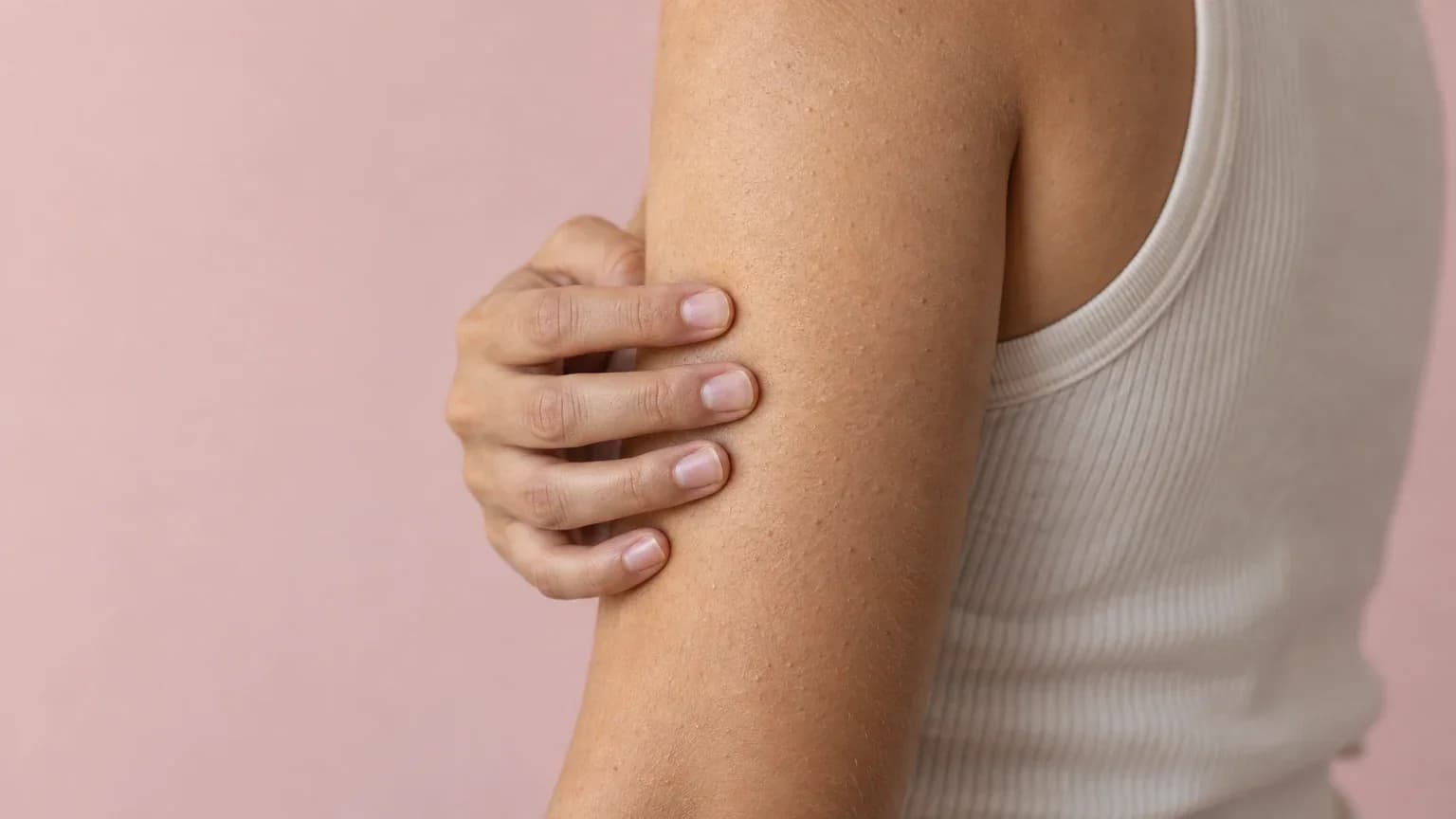
"Strawberry legs" is the nickname of a look, small dark dots like the seeds on a strawberry, and keratosis pilaris is one of the common reasons for it. One is something you see, the other something you feel. Behind the dots there can be a clogged pore whose oil darkens in the air, or keratosis pilaris, where keratin forms hard plugs in the hair follicles and the bumps feel rough and dry. The advice for each is not quite the same, and three signs tell you whether keratin is likely behind yours.
If the pages you read contradicted each other, you were paying attention. Cleveland Clinic lists keratosis pilaris among five reasons for strawberry legs and, in the same paragraph, calls it a different condition. A US hospital system puts it most plainly, writing that "strawberry skin" isn't a medical term and that several skin conditions can contribute to it. The daily routine for the look as a whole is in our guide to strawberry skin.
A clogged pore and a plug of keratin, under the skin
Start with the dot. As Cleveland Clinic explains it, a pore gets clogged with oil, dead skin, bacteria or dirt. Shaving or waxing exposes that oil to the air, and it turns darker than usual. The result looks like a blackhead.
A blackhead is black, and that black is not dirt. Depending on the dermatology reference you open, it is the buildup in the open pore reacting with oxygen in the air or melanin, the skin's own pigment. Both are writing about acne, not about legs.
Keratosis pilaris is another kind of blockage. Keratin, a protein of the skin, forms hard plugs inside the hair follicles, and the bumps look like goosebumps or plucked chicken skin. When doctors examined the bumps of 25 people under magnification, they found a curled or coiled hair inside the affected follicles of all 25.
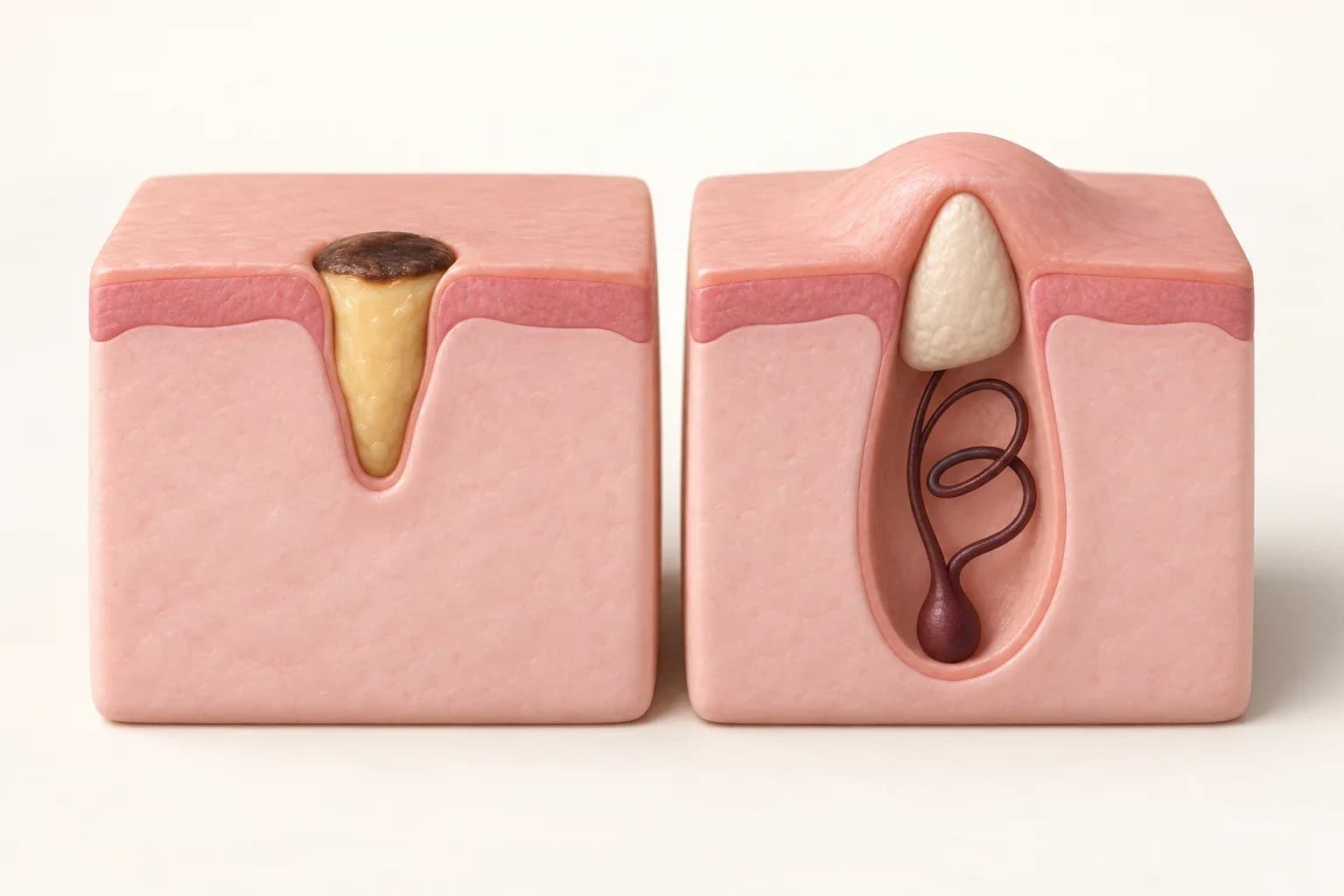
Keratosis pilaris is harmless, and you have plenty of company, since it affects about 50 to 70% of teenagers and about 40% of adults.
Three signs to check: touch, place, season
Two minutes and your fingertips are all you need. You are sorting here, and a diagnosis stays a professional's job.
- Touch. Run your fingertips over the skin. If it feels rough and dry like sandpaper, think keratin. If there is nothing to feel, keratosis pilaris is unlikely, because it is by definition something you can feel.
- Place. Check the backs of your upper arms, the fronts of your thighs and your buttocks, the usual places for keratosis pilaris. The arms are the steadier sign: in a survey of 49 children and young adults with keratosis pilaris, 92% had it on the arms and 59% on the legs. If you find bumps in those places, on the arms above all, think keratin.
- Season and razor. Is your skin worse in January than in July? Keratosis pilaris is generally worse in winter and often clears in summer. Dark dots most commonly show up after shaving or waxing, but the razor settles nothing by itself, because shaving or waxing skin that has keratosis pilaris can cause more bumps. So let the calendar decide. If your skin gets rougher every winter, think keratin.
The three signs point one way only, toward keratin, so three nos make keratosis pilaris unlikely without telling you what your dots are instead.
| What to compare | Clogged pore | Keratin plug |
|---|---|---|
| What blocks it | Oil and dead skin | Keratin, a skin protein |
| What you see | Dark dots, like blackheads | Bumps like goosebumps |
| Where | Usually the legs | Upper arms, thighs, buttocks |
| When it shows most | After hair removal | In winter |
On lighter skin the dots show more, while keratosis pilaris bumps are usually skin-colored and can look red on white skin or darker on brown or black skin.
What if you have both dots and bumps?
Then you may simply have both. Clogged pores and keratosis pilaris appear in the same list of five reasons for strawberry legs, and nothing we read says one excludes the other. That can mean rough bumps on your arms and thighs, plus dark dots on your legs after a shave. Sort each area on its own, because scrubbing can make the bumps worse.
Strawberry legs when you don't shave
Keratosis pilaris needs no razor. Nobody we read answers this question head-on, so what follows is our own reasoning. The plugs are keratin, and the condition usually starts before age 2 or in the teenage years. Pores can clog without a razor too. So if the dots are there and you never shave, run the three signs again. If your skin is rough, on the arms as well, and worse in winter, think keratin.
What a clogged pore and a keratin plug each respond to
We started unberry out of one frustration: products that worked on the surface of rough, bumpy skin and never on what sits just under it.
If your dots follow the razor, look at the razor first: they can come from an old, dull blade or shaving without cream. Then exfoliate regularly with a washcloth or loofah, and moisturize.
On keratin bumps, go easy with that loofah, because scrubbing tends to irritate the skin and make keratosis pilaris worse. The AAD advises a product with an alpha hydroxy acid, glycolic acid, lactic acid, a retinoid, salicylic acid or urea, then a thick moisturizer. Nothing clears keratosis pilaris for good, and if you stop, expect the bumps back. Over 60% of the dermatologists who answered one survey saw them return within three months of stopping salicylic acid or a store-bought moisturizer. A review of 47 articles found laser the best-supported approach.
If the signs said rough and bumpy, our Glycolic Acid Smoothing Body Cream is a cosmetic made to smooth that look, with 7% glycolic acid, 2% salicylic acid, 1% lactic acid, 2% urea and 2% niacinamide. The first four belong to families the AAD names, without a strength, and we make no claim that the cream acts on keratosis pilaris. It is not a medical treatment and will not do what a prescription or a laser does. Patch test before first use, and keep it off broken, irritated or freshly shaved skin. Alpha hydroxy acids make skin more sensitive to the sun, so wear sunscreen while you use it and for a week after.
When to see a professional
See a doctor or dermatologist if:
- the spots hurt, swell or itch, which ordinary dots usually do not
- they spread to other areas, feel firm or painful, drain fluid or come with a fever, the reasons Cleveland Clinic gives to call a provider about folliculitis
- they appeared all at once, like a sudden acne breakout, the usual look of folliculitis
- the bumps bother you and lotions from the store have not helped
If none of the three signs sounds like your skin, a clogged pore is still possible, and so are other causes. For "strawberry skin," a US hospital system also lists folliculitis, ingrown hairs and acne. Telling those apart is a professional's work, and three signs at home will not do it.
Sources17 references
- UPMC HealthBeat: How Can I Treat Strawberry Skin?
- Cleveland Clinic: 5 Ways To Get Rid of Strawberry Legs
- Cleveland Clinic: Folliculitis
Show all 17 sourcesShow fewer
- American Academy of Dermatology: Acne: Signs and symptoms
- American Academy of Dermatology: Keratosis pilaris: Signs and symptoms
- American Academy of Dermatology: Keratosis pilaris: Who gets and causes
- American Academy of Dermatology: Keratosis pilaris: Self-care
- American Academy of Dermatology: Folliculitis
- DermNet: Comedonal acne
- MedlinePlus: Keratosis pilaris
- British Association of Dermatologists: Keratosis pilaris, patient information leaflet
- NHS: Keratosis pilaris
- British Journal of Dermatology: Natural history of keratosis pilaris (1994)
- International Journal of Trichology: dermoscopy study of keratosis pilaris, Thomas and Khopkar (2012)
- Journal of Drugs in Dermatology: Keratosis Pilaris: Treatment Practices of Board-Certified Dermatologists (2023)
- Journal of Dermatological Treatment: systematic review of keratosis pilaris treatments, Maghfour and colleagues (2022)
- U.S. Food and Drug Administration: Alpha Hydroxy Acids