Keratosis pilaris, explained
Skin guide
The small rough bumps, and what is behind them
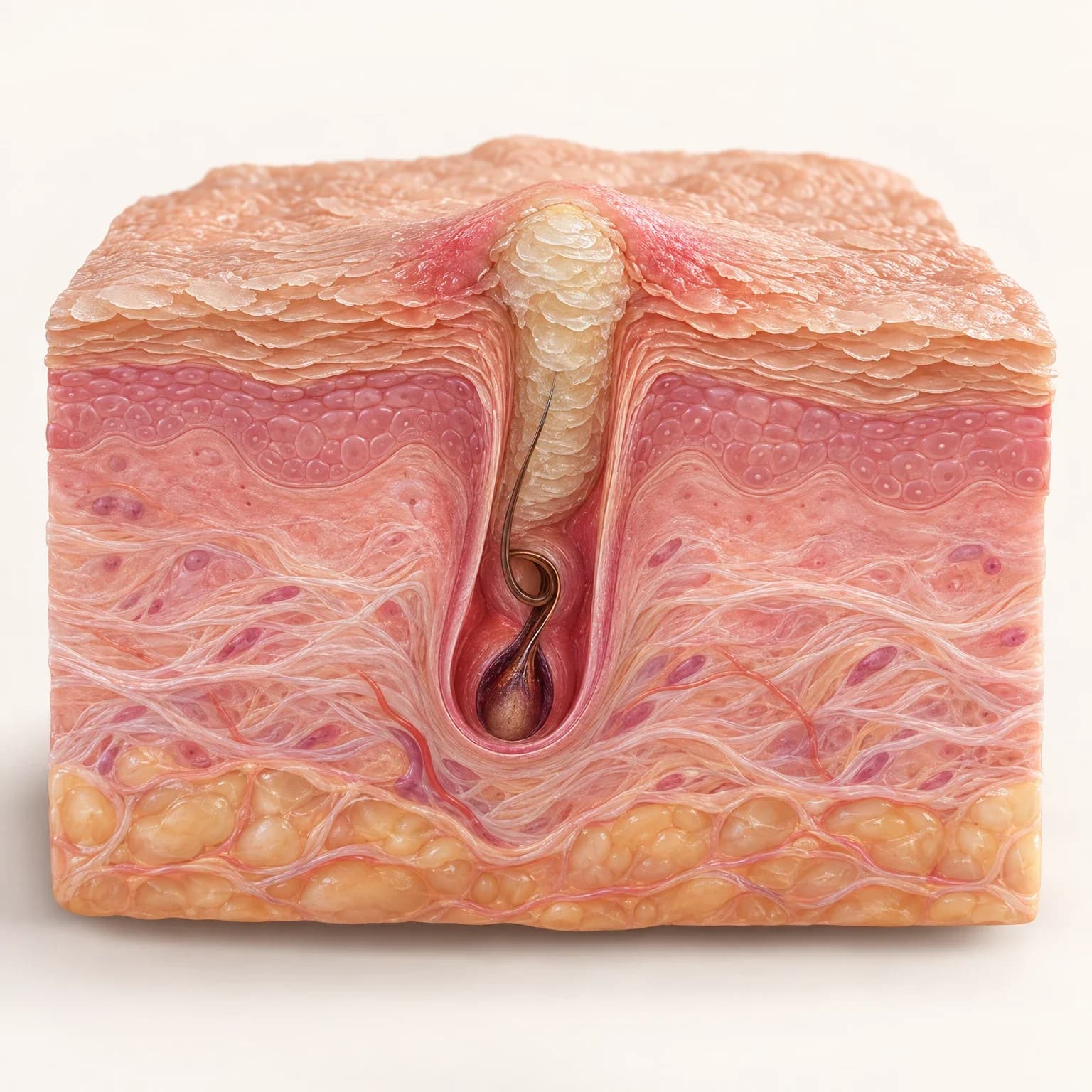
Keratosis pilaris is a common skin condition in which keratin, a protein of the skin, forms hard plugs inside the hair follicles. Each plug makes one small rough bump, and a patch of them is what people nickname "chicken skin." It is harmless, and it affects about 50 to 70% of teenagers and about 40% of adults.
What it looks and feels like
The bumps feel rough and dry like sandpaper, and they look like goosebumps or the skin of a plucked chicken.
The color depends on your skin. The bumps are usually the color of the skin around them, and they can look red on white skin, or darker on brown or black skin.
Cleveland Clinic writes that the patches resemble the dotted skin of a strawberry, which is where "strawberry legs" enters the conversation. That nickname covers more than one thing, and our article on strawberry legs and keratosis pilaris tells the two apart.
Where it shows up
The classic places are the backs of the upper arms and the fronts of the thighs, and the buttocks. In people who have many bumps, they extend to the lower legs and forearms.
- For the proportions, one small group is the 49 people with keratosis pilaris who answered a questionnaire in one English district, aged 18 months to 25 years: the arms were affected in 92%, the legs in 59%, the face in 41% and the buttocks in 30%.
- A second small group is the 50 patients of a trial in Bangkok: the arms were affected in 93% and the legs in 26%.
Both groups were diagnosed patients, so neither describes everyone who has the condition. They agree on the arms and differ widely on the legs.
Who gets it, and when
Keratosis pilaris usually starts before age 2 or in the teenage years. The British Association of Dermatologists says the cause is not fully understood but that it appears to be associated with certain genes. In the English survey, 61% of the 49 patients were female.
It also keeps a calendar. It is generally worse in winter and often clears in the summer, and 80% of the patients in that survey noticed their skin change with the seasons.
What is happening in the follicle
Picture a hair follicle as a tiny chimney, stopped up by its hard plug of keratin. What puts the plug there is less settled. Doctors who examined the bumps of 25 patients under magnification found a coiled hair inside the plugged follicles of all 25. They propose that the curled hair comes first and the keratin follows. That is one hypothesis from one small study.
What makes it worse
- Scrubbing. Scrubbing the bumps irritates the skin and worsens keratosis pilaris, and harsh scrubs can make it worse.
- Shaving and waxing. On skin that has keratosis pilaris, they can cause more bumps. Laser hair removal does not have that effect.
- Winter. Two things feed the cold-season flare: drier skin, and more rubbing against thick clothing.
What dermatologists advise
The American Academy of Dermatology describes three steps: exfoliate gently without scrubbing, apply a product that contains an alpha hydroxy acid, glycolic acid, lactic acid, a retinoid, salicylic acid or urea, then a thick moisturizer on damp skin, at least two or three times a day. For that moisturizer, the Academy prefers creams with urea or lactic acid. Alpha hydroxy acids make skin more sensitive to the sun, so sun protection goes with them. Neither the Academy's page nor the British and NHS pages give a percentage for any ingredient.
What the small trials tested
The percentages you may have seen come from a few small trials:
- 10% lactic acid and 5% salicylic acid creams. In a trial of 50 people, they were applied twice a day on the upper arms for 12 weeks. The number of bumps fell by 66% and 52% on average, with mild local irritation as the only side effect. There was no untreated group to compare with.
- 20% urea in a moisturizing cream. 30 adults used it for 4 weeks. Smoothness and texture scores improved after 1 week and after 4. Again, there was no comparison group.
- 50% or 70% glycolic acid, applied in a clinic. 25 people received it for 5 or 7 minutes, four times at 20-day intervals. By the study's own measure of effectiveness, the figure was 60% at day 80. In the 9 people followed up five years later, nothing differed from before the sessions.
Those strengths and results belong to those trials and the products tested in them. They say nothing about any other product.
How long, and what happens if you stop
Creams improve the appearance of keratosis pilaris. That is the wording of a review of 47 articles, the same one that found laser to be the approach with the best support.
Appearance is the honest word. Treatments do not clear keratosis pilaris completely; they improve it for a time. In a survey of dermatologists, over 60% of those who answered had seen the bumps come back within three months once salicylic acid or a store-bought moisturizer was stopped.
On how long it takes, the references disagree: the American Academy of Dermatology tells people following a dermatologist's plan to go back if they see no improvement after 4 to 6 weeks, while MedlinePlus says improvement often takes months.
The daily routine for bumpy skin in general is in our guide to strawberry skin.
We make a cosmetic body cream for the look of rough, bumpy skin. We make no claim that it acts on keratosis pilaris, and it is not a medical treatment.
Does it go away?
Often with age, and not for everyone. The American Academy of Dermatology says that when it starts in the teens, it often clears by the mid-20s. The NHS says most people have it for years.
The only survey we found is less cheerful. Among its 49 patients, none older than 25, the condition improved with age in 35%, stayed unchanged in 43% and worsened in 22%.
Whether it fades for good as you get older, nobody can promise.
When to see a professional
Only a professional can tell you that what you have is keratosis pilaris. A medical journal names folliculitis, acne and milia as look-alikes. See a doctor or dermatologist if:
- the bumps bother you and lotions you buy without a prescription have not helped
- you have any pain, swelling or itching with bumps or dots on your legs
This page shares general information about skin. It is not medical advice and does not replace a consultation.
Sources18 references
- MedlinePlus: Keratosis pilaris
- American Academy of Dermatology: Keratosis pilaris, signs and symptoms
- American Academy of Dermatology: Keratosis pilaris, who gets and causes
Show all 18 sourcesShow fewer
- American Academy of Dermatology: Keratosis pilaris, self-care
- American Academy of Dermatology: Keratosis pilaris, diagnosis and treatment
- British Association of Dermatologists: Keratosis pilaris, patient information leaflet
- NHS: Keratosis pilaris
- Cleveland Clinic: Keratosis Pilaris
- Cleveland Clinic: 5 Ways To Get Rid of Strawberry Legs
- British Journal of Dermatology: Natural history of keratosis pilaris (1994)
- International Journal of Trichology: dermoscopy study of keratosis pilaris, Thomas and Khopkar (2012)
- Dermatology Research and Practice: Epidermal Permeability Barrier in the Treatment of Keratosis Pilaris (2015)
- Journal of Drugs in Dermatology: Evaluation of a Moisturizing Cream with 20% Urea for Keratosis Pilaris (2024)
- World Journal of Clinical Cases: keratosis pilaris treated by a high concentration of glycolic acid, 5-year follow-up (2021)
- Journal of Drugs in Dermatology: Keratosis Pilaris: Treatment Practices of Board-Certified Dermatologists (2023)
- Journal of Dermatological Treatment: systematic review of keratosis pilaris treatments, Maghfour and colleagues (2022)
- HCA Healthcare Journal of Medicine: review of keratosis pilaris, Lim and colleagues (2026)
- U.S. Food and Drug Administration: Alpha Hydroxy Acids